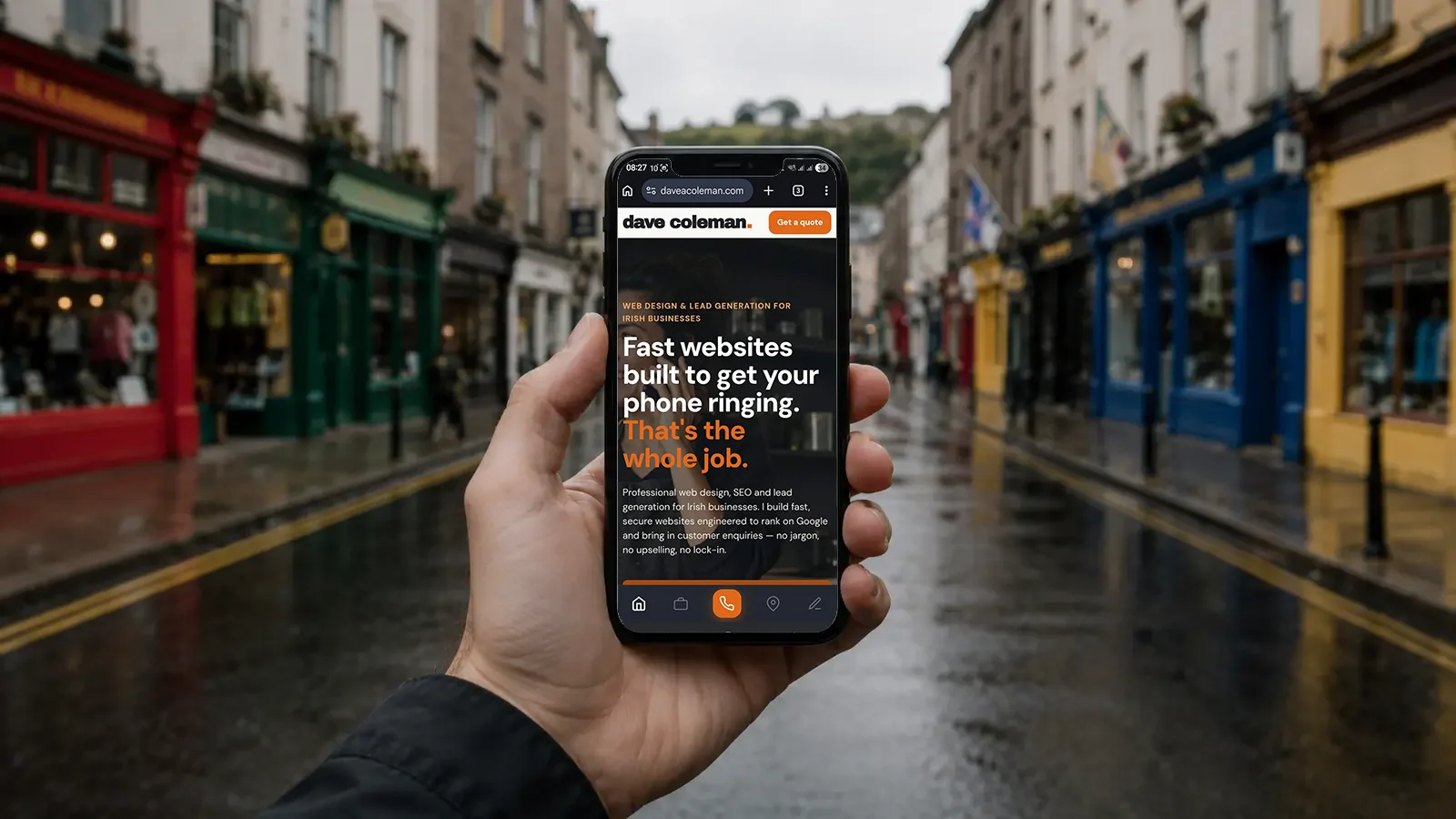
Most Irish business websites were built for desktop first. You can tell because when you pull them up on a phone, you find yourself pinching to zoom, hunting for the phone number, and waiting for images to load. By the time the page is usable, your customer has already gone back to Google.
This is the mobile problem. And it’s worth taking seriously.
Why mobile matters more in Ireland than you might think
Ireland has one of the highest smartphone penetration rates in Europe. The combination of widespread 4G, a relatively young population, and a strong culture of searching locally on the go means that for most Irish trades, hospitality, and services businesses, the majority of website visitors arrive on a phone.
Google’s own data consistently shows that Irish local searches — “electrician Dublin”, “café near me”, “plumber Cork” — skew heavily mobile. People search when they need something, and that’s rarely when they’re sitting at a desk.
The businesses that understand this build their sites for a phone first. The ones that don’t are building for a use case that’s increasingly rare.
What Google does with mobile experience
In 2019, Google switched to mobile-first indexing. This means it crawls the mobile version of your site to decide how to rank you — the desktop version is secondary. If your mobile site is slow, stripped of content, or hard to use, your rankings reflect that — even if your desktop site looks great.
The specific signals Google measures are called Core Web Vitals:
Largest Contentful Paint (LCP) — how long until the main content on the page is visible. Should be under 2.5 seconds. Most Irish WordPress sites fail this badly.
Interaction to Next Paint (INP) — how quickly the page responds when a user taps something. Slow JavaScript loading tanks this.
Cumulative Layout Shift (CLS) — whether things move around as the page loads. Images without dimensions, fonts loading late, and injected ads all cause this.
Failing these metrics pushes you down. Passing them gives you a clear ranking advantage over competitors who haven’t bothered.
The three things that actually matter on mobile
There’s a lot of noise about mobile web design — responsive layouts, breakpoints, thumb zones. Most of it is technical detail. Here’s what actually moves the needle for an Irish small business:
1. Speed
On a mobile connection — even a fast 5G one — loading time is everything. Every additional second of load time increases bounce rate significantly. People on phones are impatient because they’re usually searching with immediate intent. They found you in a search, they’re considering you, and if the page doesn’t load fast they’re gone.
The way to get genuinely fast load times is structural. Cloudflare Pages serves your site from a global network with no server processing time — pages load in milliseconds rather than seconds. WordPress with plugins can be optimised but it’s fighting against its own architecture.
2. A phone number that taps to call
This sounds obvious but a surprising number of Irish business websites still display a phone number as plain text that you have to copy and dial manually. Every step between “I want to call” and “phone is ringing” loses customers.
A properly built mobile site wraps every phone number in a tel: link. Tap it, phone rings. That’s the entire experience.
3. Clear hierarchy on a small screen
On a desktop, you have space to show a lot at once. On a 390px-wide phone screen, everything stacks. If your most important information isn’t at the top — what you do, where you do it, how to contact you — a mobile visitor has to scroll to find it. Many won’t.
Every page should have a clear mobile hierarchy: headline, brief qualifier, contact action. Everything else is secondary.
The Irish mobile context specifically
Irish mobile users searching for local businesses have specific patterns worth understanding:
They search by area. “Web designer Galway”, “plumber Limerick”, “solicitor Kilkenny” — these are the searches. Your site needs to name the area it serves, clearly and early, so the person who just searched for your service in their town knows immediately they’ve found something relevant.
They check Google Business Profile first. Before they even click your website, they’ve likely seen your Google Business Profile — your star rating, your photos, your address. If that’s missing or underdeveloped, they may not make it to your site at all. See setting up Google Business Profile for Irish businesses.
They’re on the move. Someone searching “electrician near me” at 10am on a Tuesday is probably standing in a room with an electrical problem. They want to call someone, not read a brochure. Design for that person.
What a properly built mobile site looks like
The sites that work best on mobile in Ireland share the same characteristics:
- Load in under a second on a standard Irish 4G connection
- Show the business name, service, and location in the first screenful
- Have a visible, tappable phone number in the header
- Use images that are compressed and sized correctly (WebP format, appropriate dimensions)
- Have text that’s readable at default zoom — no pinching required
- Stack navigation into a simple menu that’s easy to use with a thumb
None of this is radical. But it describes fewer than half of the small business websites currently live in Ireland.
Getting your mobile experience right
If you want to know where your site stands right now, run it through Google PageSpeed Insights and look at the mobile score. Anything under 70 is a problem. Anything under 50 is a serious problem that’s costing you customers.
If you want help fixing it — whether that’s a rebuild or a focused audit of what’s broken — get in touch. I’ll give you an honest read on what’s actually wrong and what’s worth fixing. No sales pitch.
And if you want to see what a properly built mobile site looks like across Ireland, the web design section covers every city I work in — Dublin, Cork, Galway, and beyond.